
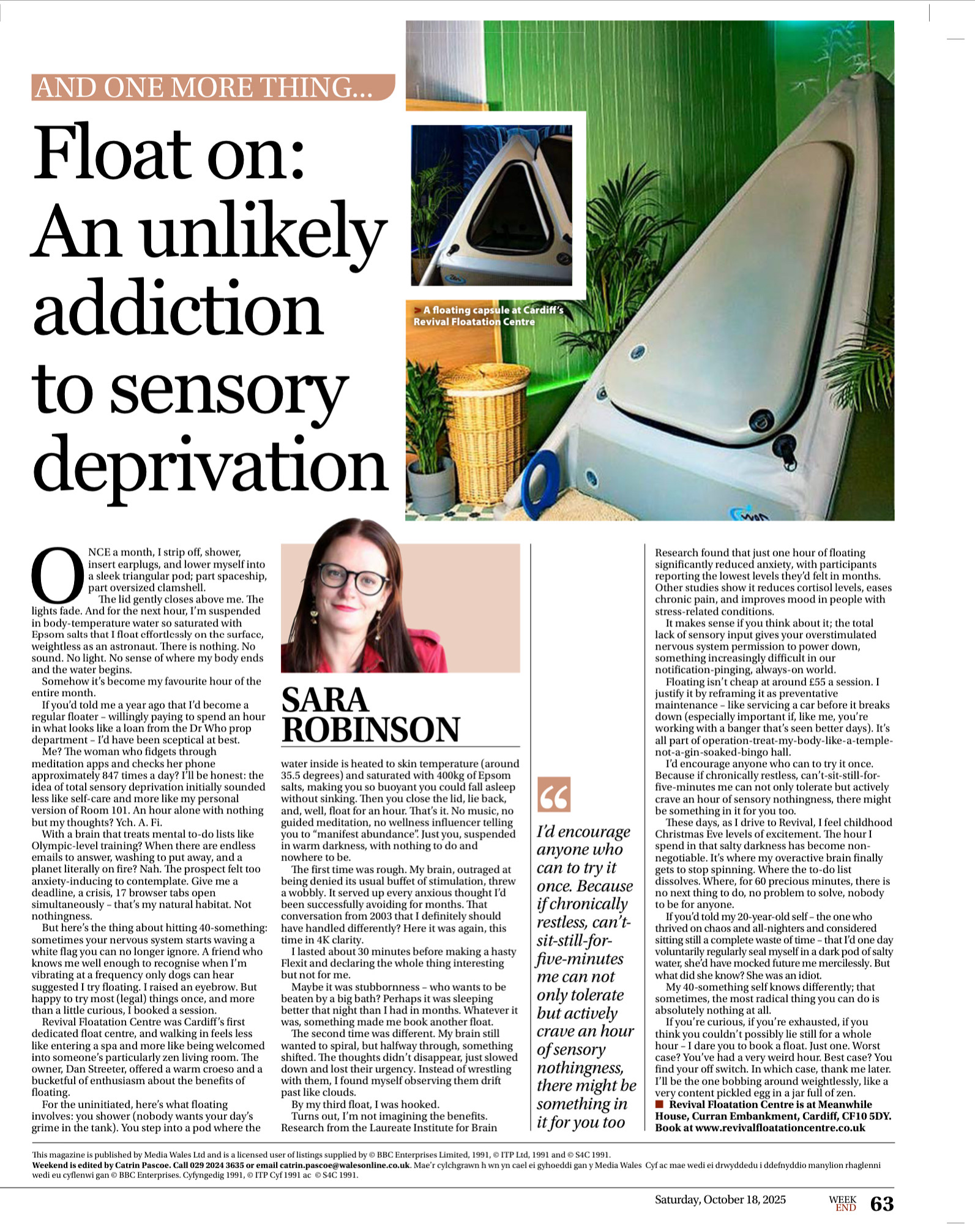
Once a month, I strip off, shower, insert earplugs, and lower myself into a sleek triangular pod; part spaceship, part oversized clamshell. The lid gently closes above me. The lights fade. And for the next hour, I’m suspended in body-temperature water so saturated with Epsom salts that I float effortlessly on the surface, weightless as an astronaut. There is nothing. No sound. No light. No sense of where my body ends and the water begins.
Somehow it’s become my favourite hour of the entire month.
If you’d told me a year ago that I’d become a regular floater – willingly paying to spend an hour in what looks like a loan from the Dr Who prop department – I’d have been sceptical at best.
Me? The woman who fidgets through meditation apps and checks her phone approximately 847 times a day? I’ll be honest: the idea of total sensory deprivation initially sounded less like self-care and more like my personal version of Room 101. An hour alone with nothing but my thoughts? Ych. A. Fi.
With a brain that treats mental to-do lists like Olympic-level training? When there are endless emails to answer, washing to put away, and a planet literally on fire? Nah. The prospect felt too anxiety-inducing to contemplate. Give me a deadline, a crisis, seventeen browser tabs open simultaneously – that’s my natural habitat. Not nothingness.
But here’s the thing about hitting 40-something: sometimes your nervous system starts waving a white flag you can no longer ignore. A friend who knows me well enough to recognise when I’m vibrating at a frequency only dogs can hear suggested I try floating. I raised an eyebrow. But happy to try most (legal) things once, and more than a little curious, I booked a session.
Revival Floatation Centre was Cardiff’s first dedicated float centre, and walking in feels less like entering a spa and more like being welcomed into someone’s particularly zen living room. The owner, Dan Streeter, offered a warm croeso and a bucketful of enthusiasm about the benefits of floating.
For the uninitiated, here’s what floating involves: You shower (nobody wants your day’s grime in the tank). You step into a pod where the water inside is heated to skin temperature (around 35.5 degrees) and saturated with 400kg of Epsom salts, making you so buoyant you could fall asleep without sinking. Then you close the lid, lie back, and, well, float for an hour. That’s it. No music, no guided meditation, no wellness influencer telling you to “manifest abundance.” Just you, suspended in warm darkness, with nothing to do and nowhere to be.
The first time was rough. My brain, outraged at being denied its usual buffet of stimulation, threw a wobbly. It served up every anxious thought I’d been successfully avoiding for months. That conversation from 2003 that I definitely should have handled differently? Here it was again, this time in 4K clarity!
I lasted about 30 minutes before making a hasty Flexit and declaring the whole thing interesting but not for me.
Maybe it was stubbornness – who wants to be beaten by a big bath? Perhaps it was sleeping better that night than I had in months. Whatever it was, something made me book another float.
The second time was different. My brain still wanted to spiral, but halfway through, something shifted. The thoughts didn’t disappear, just slowed down and lost their urgency. Instead of wrestling with them, I found myself observing them drift past like clouds.
By my third float, I was hooked.
Turns out, I’m not imagining the benefits. Research from the Laureate Institute for Brain Research found that just one hour of floating significantly reduced anxiety, with participants reporting the lowest levels they’d felt in months. Other studies show that it reduces cortisol levels, eases chronic pain, and improves mood in people with stress-related conditions.
It makes sense if you think about it; the total lack of sensory input gives your overstimulated nervous system permission to power down, something increasingly difficult in our notification-pinging, always-on world.
Floating isn’t cheap at around £55 a session. I justify it by reframing it as preventative maintenance—like servicing a car before it breaks down (especially important if, like me, you’re working with a banger that’s seen better days). It’s all part of operation-treat-my-body-like-a-temple-not-a-gin-soaked-bingo hall.
I’d encourage anyone who can to try it once. Because if chronically restless, can’t-sit-still-for-five-minutes me can not only tolerate but actively crave an hour of sensory nothingness, there might be something in it for you too.
These days, as I drive to Revival, I feel childhood Christmas Eve levels of excitement. The hour I spend in that salty darkness has become non-negotiable. It’s where my overactive brain finally gets to stop spinning. Where the to-do list dissolves. Where, for 60 precious minutes, there is no next thing to do, no problem to solve, nobody to be for anyone.
If you’d told my 20-year-old self – the one who thrived on chaos and all-nighters and considered sitting still a complete waste of time – that I’d one day voluntarily seal myself in a dark pod of salty water on the regular, she’d have mocked future me mercilessly. But what did she know? She was an idiot.
My 40-something self knows differently; that sometimes, the most radical thing you can do is absolutely nothing at all.
If you’re curious, if you’re exhausted, if you think you couldn’t possibly lie still for a whole hour – I dare you to book a float. Just one. Worst case? You’ve had a very weird hour. Best case? You find your off switch. In which case, thank me later. I’ll be the one bobbing around weightlessly, like a very content pickled egg in a jar full of zen.
Revival Floatation Centre is at Meanwhile House, Curran Embankment, Cardiff, CF10 5DY. Book at www.revivalfloatationcentre.co.uk.

 silverdiscodaps.com
Leave a comment